
Asbestos surveys
Choose the right survey for you
All buildings constructed before 2000 could contain asbestos.
| If you are… | You need |
|---|---|
| Responsible for an office, shop, school, factory or other non-domestic building | Management survey |
| Managing the communal areas of a block of flats (hallways, stairs, plant rooms) | Management survey |
| Planning a refit, rewiring, new windows, or taking out walls or ceilings | Refurbishment survey |
| Keeping an existing asbestos register up to date | Re-inspection survey |
| Worried about one or two suspect materials on a small job | Sampling & testing |
| Demolishing all or part of a building | Demolition survey |
| Cutting, welding or dismantling painted steelwork | Lead paint testing |
| Sanding, stripping or burning off old paintwork | Lead paint testing |
Not sure? Call us and describe the job. We’ll tell you which survey you need, free of charge.
For buildings in everyday use
Management survey
A management survey is the standard asbestos survey for a building that is occupied and in normal use. It finds asbestos-containing materials (ACMs) that could be damaged or disturbed during day-to-day activities, routine maintenance or the installation of new equipment, cabling and pipework, and assesses the condition of each one.
Who needs one?
If you own, manage or are responsible for maintaining a non-domestic building, or the common parts of a block of flats, you have a legal duty to manage asbestos under regulation 4 of the Control of Asbestos Regulations 2012. A management survey is usually the first step: it tells you what is there so you can keep it in good condition and make sure nobody disturbs it.
What’s involved
Our surveyor inspects every accessible area: rooms, corridors and stairwells, basements, ceiling voids and lofts, risers and service ducts, lift shafts, and outside areas such as roofs, soffits and gutters. The survey is only lightly intrusive. We may lift ceiling tiles or open access hatches, but we don’t break into the building fabric, so you can usually stay in occupation while we work.
Suspect materials are sampled and analysed by a UKAS-accredited laboratory. Any area we can’t safely reach is clearly recorded and presumed to contain asbestos until it can be inspected.
After the survey
Your report gives you an asbestos register, a risk assessment for each material and recommended actions, which together form the basis of your asbestos management plan. The register should be shared with anyone who might disturb the building, such as maintenance staff and contractors, and the condition of any asbestos left in place should be re-inspected regularly, typically every 12 months.
Before building work starts
Refurbishment & demolition survey
A refurbishment and demolition (R&D) survey is needed before all or part of a building is upgraded, refurbished or demolished. Its purpose is to find every ACM in the area of the planned work, including materials hidden within walls, floors, ceilings and the building structure, so that nobody is harmed and the asbestos can be dealt with properly before work begins.
When you need one
- Kitchen and bathroom refits
- Rewiring, replumbing or replacing heating systems
- Replacing windows, doors or roof coverings
- Knocking through walls, removing partitions or ceilings
- Strip-outs, extensions and full demolition
Under regulation 7 of the Control of Asbestos Regulations 2012, where premises are to be demolished or undergo major refurbishment, asbestos must be removed, so far as reasonably practicable, before any other major works begin. Your contractor will normally ask to see an R&D survey before they start on site.
What’s involved
This survey is fully intrusive and involves destructive inspection. We may lift floorboards, open up boxing and wall linings, and break into voids to reach every part of the area being worked on. For a demolition survey, that means the whole building.
Because asbestos may be disturbed, the area must be empty during the survey. Afterwards it is checked and confirmed fit for reoccupation before anyone goes back in.
Helping us get it right
The survey is planned around your project, so the more we know, the better. Floor plans, architect’s drawings, a scope of works and any previous asbestos surveys all help us cover exactly the right areas. If the scope changes later, let us know: areas outside the original survey may need inspecting before work extends into them.
If asbestos is found
Your report gives clear guidance on any removal works required before your project goes ahead: which materials need to come out, where they are and roughly how much there is. It also explains which items are likely to be licensable. Under the Control of Asbestos Regulations 2012, most work on higher-risk materials, such as pipe lagging, sprayed coatings and asbestos insulating board, must be carried out by a contractor licensed by the HSE.
We can recommend a trusted, fully licensed asbestos removal contractor, and our report gives them the detail they need to price and plan the job.
Keeping your register current
Asbestos re-inspection survey
Asbestos left in place has to be monitored. A re-inspection survey checks the condition of every known or presumed asbestos material in your register, records any damage or deterioration, and updates the risk assessments and recommendations.
Regular re-inspections help you meet your duty to manage under regulation 4 of the Control of Asbestos Regulations 2012, which requires the condition of asbestos to be monitored and the management plan to be reviewed. Most dutyholders re-inspect every 12 months, or sooner where materials are damaged or in high-traffic areas.
For small jobs
Asbestos sampling & testing
If you only need one or two suspect materials checked, such as a textured ceiling, floor tiles or a boiler cupboard panel, we can sample them without a full survey. Samples are analysed by a UKAS-accredited laboratory and you receive a clear certificate of results.
Sampling is ideal for homeowners and minor works. It does not replace a management or refurbishment and demolition survey where one is required.
What’s in your report
Every survey includes an asbestos register, with each finding plotted on your floor plans so it’s easy to find on site.
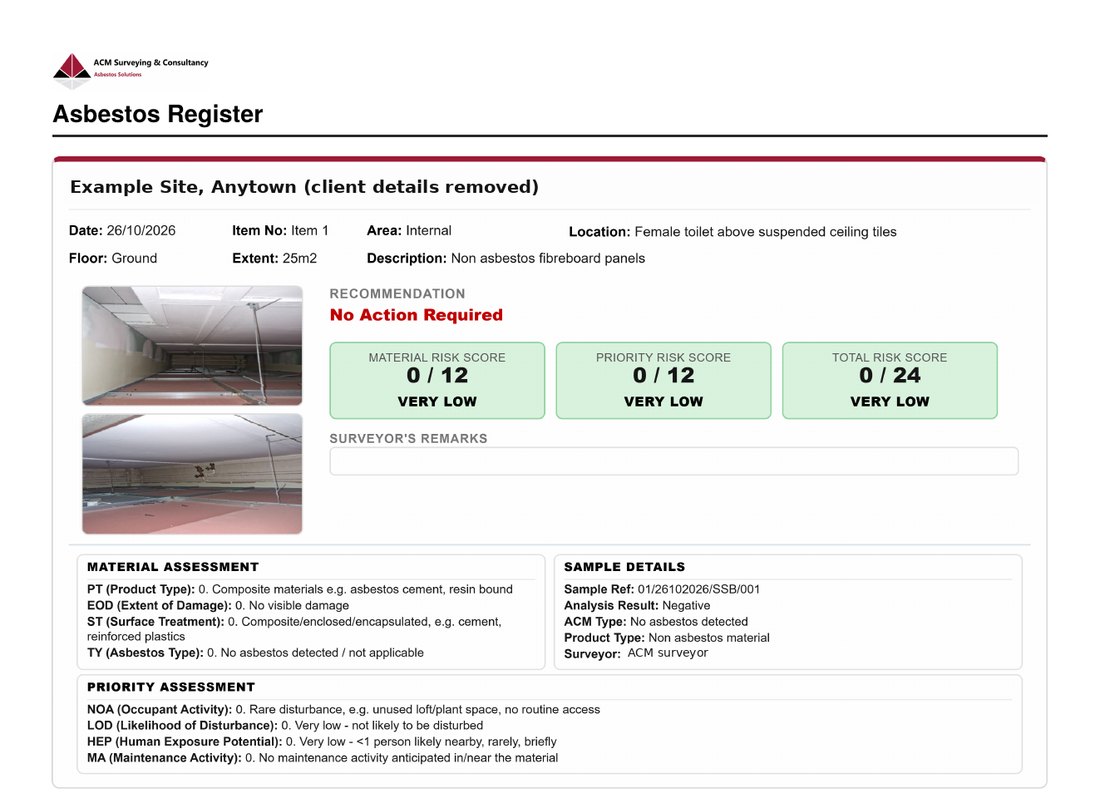
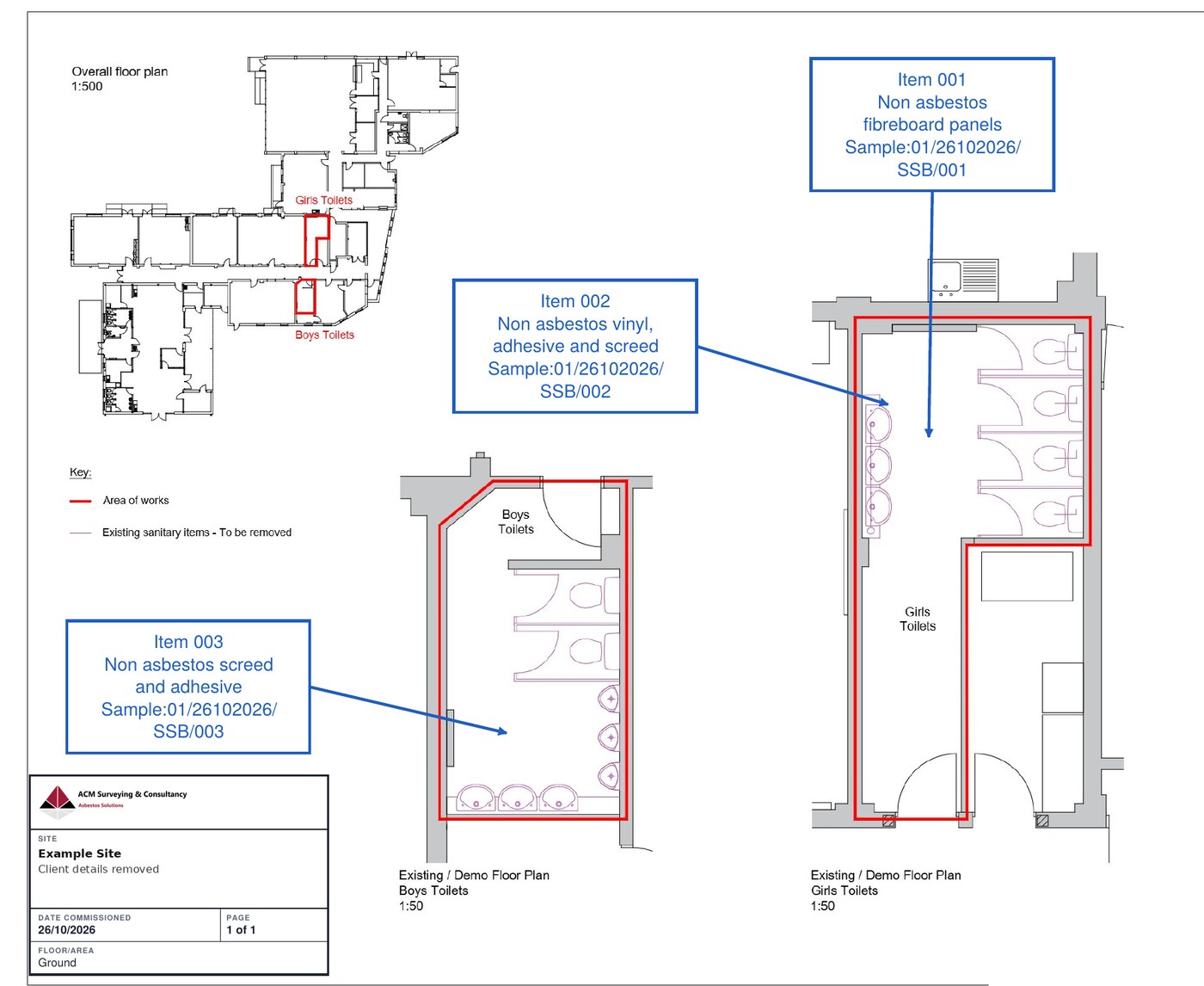
From a real refurbishment survey. Client details removed.
Download an example report (PDF)- Product type
- Location
- Extent or quantity
- Asbestos type (lab results)
- Accessibility and vulnerability
- Damage or deterioration
- Surface treatment
- Risk assessment
- Recommended actions
- Photographs
Need a survey?
Get a free, fixed quote. No hidden costs.